


What’s Inside Embroidery? How to Hide Thread Ends Like a Pro

By diver361 in Problems with Machine Embroidery Designs
· 18 views
✨ “Can you show the inside?” — Let’s talk about the hidden side of embroidery
That’s such a great question — because the real craftsmanship of embroidery isn’t just what you see… it’s what’s hidden underneath.
When you look at this denim jacket with a detailed dreamcatcher embroidery, the outside is clean, elegant, almost effortless. But inside? That’s where technique, care, and experience really show.
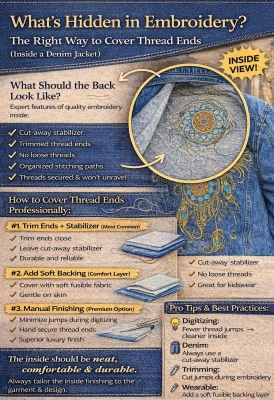
🧵 What does the inside actually look like?
On a piece like this, the inside will usually have:
Dense thread paths following the design
Stabilizer backing (often cut-away for denim)
Thread jumps trimmed cleanly
No messy knots or loose ends
It won’t look “pretty” like the front — but it should look organized and intentional, not chaotic.
🪡 How are thread ends covered?
There are several professional ways to handle thread ends — and the method depends on whether you're going for durability, comfort, or luxury finish.
💡 ✂️ 1. Clean trimming + stabilizer (most common)
After stitching:
All thread jumps are trimmed close
The stabilizer stays behind the design
Thread ends are locked by machine stitches
👉 This is what you’ll find in most high-quality embroidery — simple, strong, and reliable.
💡 🧷 2. Soft backing (comfort layer)
For wearable items like jackets:
A soft fusible backing is added on top of the stitches (inside)
Covers thread ends completely
Prevents scratching on skin
👉 This is especially important for kidswear or lightweight fabrics.
💡 🧵 3. Manual finishing (premium method)
In more refined work:
Thread ends are secured manually or minimized during digitizing
Jump stitches are reduced in the design itself
Everything looks cleaner from the start
👉 This is where good digitizing makes a huge difference.
🧠 Expert Tips (what professionals actually do)
💬 “The cleaner your digitizing — the cleaner your backside.”
Avoid excessive jump stitches at the design stage. It saves hours later.
💬 “Denim needs cut-away stabilizer — always.”
Tear-away won’t hold up. For jackets like this, durability is key.
💬 “Trim as you go, not at the end.”
Stopping during embroidery to cut jumps gives a much cleaner result.
💬 “Comfort matters more than perfection.”
If it’s wearable, always consider adding a soft backing — especially for large designs.
🧥 Why this matters for a jacket like this
This dreamcatcher design is quite large and detailed. That means:
Multiple thread color changes
Dense stitching areas
Long thread paths
Without proper finishing, the inside could feel rough or messy.
But with the right approach, it becomes:
👉 Durable
👉 Comfortable
👉 Professionally finished
✨ Final thought
The beauty of embroidery is a combination of visible art and invisible technique.
So yes — the inside may not be “Instagram-worthy”…
but when done right, it’s just as impressive as the front.
Recommended Comments