Pet & Craft · The Technical Edit · 2026
The Carrier Is Not a Tote Bag.
And That Changes Everything.
Why embroidering a pet carrier is one of the most rewarding bag projects you can take on — and one of the most technically demanding. A complete guide to methods, challenges and results.
The carrier sits on the park bench. The cat sits in the carrier. And on the front panel — a small embroidered cat releasing a heart into the air, in the same relaxed sketch style as the park, the bench, the morning light. Everything matches. Everything was made to match. This is what personalisation does when it is done right.
Pet carriers are having a moment. They have moved from functional necessity to lifestyle accessory — carried on shoulders on the way to the vet, photographed on café terraces, brought into waiting rooms where other pet owners immediately ask about them. An embroidered carrier is the logical next step: the one that makes a blank canvas bag specifically, permanently, unmistakably yours and your pet's.
The challenge is that a pet carrier is also one of the most structurally complex bags you will ever attempt to embroider. It is not flat. It has mesh panels, internal structure, zips, straps, and a fabric that ranges from canvas to quilted nylon to waxed cotton. Understanding what to expect before you start is the difference between a finished carrier that looks like the photo above and one that doesn't.
✦ ✦ ✦
"
You are not embroidering a bag. You are embroidering the thing your pet travels in — and that changes everything about what it means to get it right.
Why a pet carrier is not like any other bag
A tote bag has two flat panels joined at the sides and bottom. You insert a hoop from the open top, float the fabric, stitch. A pet carrier has a structured internal frame, ventilation mesh on two or three sides, a zip opening at the top, shoulder straps, and a front panel that curves gently outward to accommodate the animal inside. That front panel — the one you want to embroider — is typically canvas, but it is attached to everything else and cannot be simply flattened, hooped and stitched the way flat fabric can.
The community consensus drawn from dozens of embroidery forum discussions, tutorial posts and practical guides is clear: the single most important decision when embroidering any bag — including a pet carrier — is whether to embroider before or after construction. Everything else is technique. This decision is strategy.
The flat-panel solution used by experienced embroiderers on all structured bags: buy the carrier, carefully open the front panel seam, embroider the flat fabric while it is removed from the bag, then re-sew the seam. The result is a professionally placed design on a correctly tensioned surface — and a carrier that looks exactly like the one in the photo above.
Three approaches — ranked by result quality
What the embroidery community has learned from experience
BEST
Embroider the panel before or after opening the seam
Open the front panel seam carefully with a seam ripper. Remove the panel as a flat piece of fabric. Embroider it while it is completely flat and unobstructed — hoop normally, stitch normally. Re-sew the seam. This is the method used by professional embroiderers and anyone making a carrier from scratch. It produces clean, professional results because the fabric behaves exactly as flat fabric should. The cardinal rule from experienced embroiderers: embroider on uncut fabric first, then cut the pattern piece, then sew into the final project.
Ideal for
Canvas, heavy cotton and waxed cotton carriers with sewn seams · Carriers you are making from scratch · Any project where perfect registration matters
GOOD
Float hooping on the assembled carrier
Hoop a piece of medium-weight tear-away or cut-away stabilizer alone — drum-tight. Apply temporary spray adhesive to the stabilizer surface. Carefully position the front panel of the assembled carrier over the hooped stabilizer, smoothing from centre outward. Clip or baste any straps and mesh panels away from the embroidery area to prevent accidental stitching. The key is to make sure the fabric is still tightly attached to the stabilizer underneath and has no possible way of shifting while the machine is moving the hoop.
This works well on canvas carriers because canvas is stable, does not stretch, and adheres predictably to spray adhesive. The main challenge is managing everything that is attached to the panel — straps, zips, handles — which must be carefully pinned or taped away from the needle path.
Ideal for
Ready-made canvas carriers where opening the seam is not practical · Smaller designs that fit within the accessible front panel area · Embroiderers comfortable with float hooping technique
COMPLEX
Patch embroidery — embroider separately, attach afterwards
Embroider the design on a separate piece of canvas, linen or felt — flat and perfectly hooped. Cut the embroidered piece to the desired shape. Attach it to the carrier front panel by hand-sewing around the edges, using fabric glue rated for canvas, or both. The result is a visible patch aesthetic that, when done intentionally, can look designed rather than improvised.
This method is the most accessible for beginners — it requires no float hooping skill and no seam opening — but it produces a different visual result. The patch edge will be visible. Whether this is a flaw or a design feature depends entirely on how it is handled.
Ideal for
Nylon or synthetic carriers where direct embroidery is not practical · Beginners who want a safe first attempt · Designs where the patch aesthetic is intentional and suits the carrier style
The Technical Edit
Five challenges specific to pet carriers
01 Straps and handles in the needle path
The most common disaster. Entirely preventable.
A pet carrier's shoulder straps, handle loops and zip pulls all fall naturally toward the front panel — directly into the needle path if not managed. Before the machine runs a single stitch, tape every strap, loop and zip pull to the sides or back of the carrier using masking tape or binder clips. Remove the straps and extra edges away from the center to prevent the possibility of being embroidered. Check twice. Run the hoop through its travel range by hand before stitching to confirm nothing is in range.
02 Canvas thickness and needle penetration
Heavy canvas needs a heavy needle. And a slower machine.
Pet carrier canvas is typically 10–14oz weight — heavier than most garment fabric, similar to denim or upholstery canvas. Use a size 90/14 or 100/16 sharp needle. Reduce machine speed to 70–80% maximum. Heavy canvas causes needles to deflect slightly at speed, creating stitch inconsistency in fine lettering and sketch-style designs. Slow stitching equals clean penetration equals sharp results.
03 Internal structure interferes with the hoop
The carrier's frame is inside. Your hoop needs to get underneath the panel.
Most pet carriers have a rigid base and semi-rigid frame that prevents the front panel from sitting flat for hooping. When float-hooping on an assembled carrier, the frame raises the panel at the edges, creating uneven tension. Solve this by placing the hooped stabilizer under the panel with the carrier body resting on its side — letting gravity help flatten the panel against the stabilizer rather than fighting the frame.
04 Design size versus accessible panel area
The embroiderable area is smaller than the panel looks.
The visible front panel of a pet carrier may be 25×20cm — but the embroiderable area, once you account for seam allowances, zip proximity, mesh panel edges and strap attachment points, is often 15×12cm or less. Sketch-style designs at 10–14cm wide work perfectly. Large, dense fills that approach the edges will run into obstacles. When your design is larger than your hoop, split it into two hoopings — this method is invaluable for any project larger than your available hoop size.
05 Stabilizer choice for canvas
Canvas is woven — tear-away is the correct choice. But use two layers.
Unlike knit fabrics, canvas does not stretch — which means cut-away is not required for stability. Medium-weight tear-away stabilizer removes cleanly from canvas after stitching, leaving no residue or stiffness. For heavier designs or carriers where the panel is particularly thick, use two layers of tear-away for additional mass and resistance. On the back of the embroidered area, trim tear-away close to the stitching and the finish is clean and professional.
The design that works on a carrier
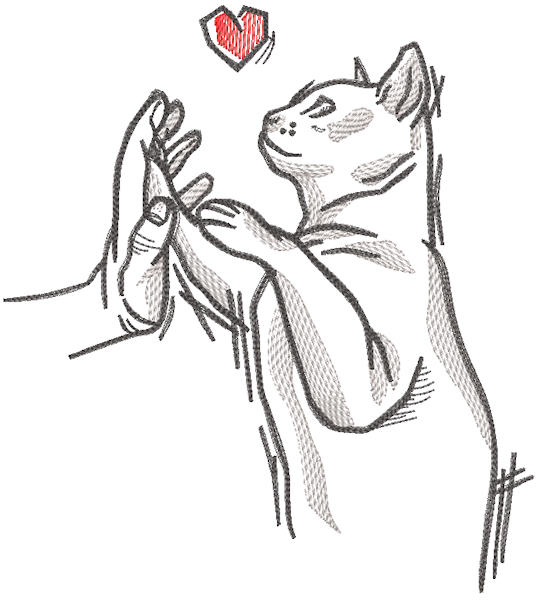
The sketch-style cat shown on the carrier above is the ideal design category for this application — and the embroidery community agrees. Open fills, running stitch outlines and minimal dense areas mean the design lies flat, doesn't stiffen the canvas, and ages well through the scratching, rubbing and general handling that a pet carrier receives. A dense fully-filled design on a pet carrier will feel rigid, crinkle at the edges after use, and eventually lose thread tension at the boundaries as the canvas flexes.
Sketch / line art style — best choice for carriers. Minimal density, maximum visual impact. Lies flat. Ages well.
Single-colour or two-colour designs — fewer thread changes, lower production risk on a complex assembled item.
Small accent elements — a red heart, a single highlighted detail — add colour impact without adding density risk.
Avoid on carriers: Dense satin fills across large areas · Very fine text under 8mm height · Designs that extend to within 2cm of any seam or mesh panel edge.
"
A carrier embroidered with a portrait of the animal inside is not a customised bag. It is a declaration. It says: this animal is loved enough to carry in something beautiful.
— Embroideres Design Studio
Ideas for what to embroider
The portrait approach
A sketch of the specific animal — the actual cat or dog who rides in this carrier. Line art of a tabby, a Persian, a corgi, a dachshund. The portrait approach makes the carrier entirely unique. The community response to these is always the same: instant recognition, immediate questions about how it was made, and that particular quality of emotion that comes when you recognise an animal in a drawing.
Name + motif
The pet's name in script with a small illustrated element — a paw print, a fish for the cat, a bone for the dog, a heart, a flower. This approach is elegant in its restraint. The name is the primary element; the motif adds warmth. Works at smaller scales (10–12cm wide) that fit comfortably within the accessible panel area of most carriers.
Generic but personal animal motif
A sketch of a cat releasing a heart balloon. A dog looking up at butterflies. A rabbit in a field. These are not portraits of a specific animal — but they communicate affection so clearly that they feel personal to anyone who sees them on a carrier. This is the approach shown in the photo above: universally readable, emotionally immediate, and versatile across all cat breeds and carrier colours.
The verdict
Embroidering a pet carrier is not a beginner project — but it is not an impossible one either. The techniques required (float hooping, canvas needle selection, strap management) are all standard embroidery skills that apply across many other bag and garment projects. What makes the carrier specific is the structural complexity and the narrower margin for error: you are working on a functional object that the animal depends on, and that the owner will carry in public.
Get it right, and you have made something that genuinely does not exist anywhere else. The carrier that has the actual cat on it. The bag that was made specifically for the animal inside it. That specificity — that connection between the object and the life it belongs to — is what machine embroidery does better than any other personalisation method. And on a pet carrier, it does it in a place where people will see it, notice it, and ask about it every time.
Test on a canvas scrap first. Open the seam if you can. Float if you can't. And choose a sketch design — always a sketch design.
Design perfect for a pet carrier
Recommended
|
Sketch style · Cat & Human · Canvas-ready
Friendship Between Cat
and Human
Open sketch-style design — exactly the category that works best on pet carriers. Low density, clean line art, no large satin fills. Lies flat on canvas, ages well with use, and says everything that needs to be said.
PES
DST
JEF
EXP
VP3
HUS
XXX
Get this design →
|
Embroidered a pet carrier? Share it in the gallery!
#PetCarrierEmbroidery
#CatCarrier
#MachineEmbroidery
#SketchEmbroidery
#PetAccessories
#FloatHooping
#CustomPetGear

.thumb.jpg.fd3d4e7001ebd0040712ee96087a4fc1.jpg)